


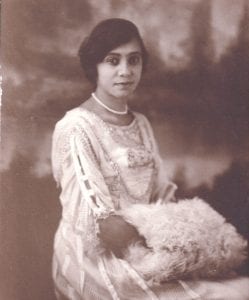
Florence Beatrice Smith Price (1887-1953). Her Symphony in E major was performed by the Chicago Symphony in 1933, making her the first recognized Black female symphonist.
Our #FacultyFriday series of videos is the time we set aside once a week to feature our world-renowned Heifetz Institute string and piano faculty. Today, we’re going zoom in – literally! – to a performance from 2020 edition of the Institute’s annual “PianoPalooza” – a showcase for the Institute’s outstanding piano faculty. From her home in Houston, TX, pianist Jessica X. Osborne brings to light a work by the seminal African-American composer Florence Beatrice Price.
Born in Little Rock, Arkansas, in 1887 to a music-teacher and a dentist father, Florence had written her first composition at the age of 11, and graduated as valedictorian of her high school class at 14. Shen then made her way to New England Conservatory in Boston, Price studied composition and counterpoint with composers George Chadwick and Frederick Converse, wrote her first string trio and symphony. She graduated from NEC in 1906 with honors and two degrees: and with both an artist diploma in organ and a teaching certificate. You’ll also see from the program of the “Commencement Concert” from 1906 that Price “closed the show” with a solo organ performance!
In 2020, a lot of Price’s music – her chamber works, symphonies, and piano pieces are enjoying a renaissance and rediscovery. Jessica Osborne’s contribution is Price’s Fantasie Nègre No. 1, from 1929. It’s dedicated to Price’s student Margaret Bonds, another female composer of color, and incorporates the African American spiritual “Please Don’t Let This Harvest Pass” with a series of variations and reharmonizations, deftly combining classical European and Negro spiritual musical idioms. Enjoy!
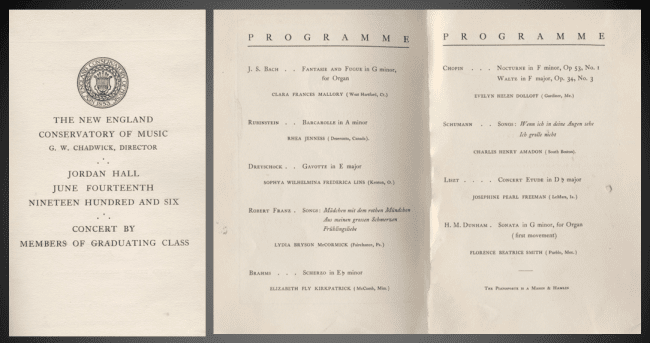
The NEC Commencement program from 1906. Florence (Smith) Price “closed the program” with a performance of the first movement of the Organ Sonata in G minor by American composer Henry Morton Dunham (1853-1929).