

The Heifetz 2027 Summer Program
Jump to: Faculty | Audition Guidelines | Application Fees | Tuition | Scholarships and Financial Aid | Program Overview | FAQ
PLAYERS WANTED for the Heifetz Institute’s 2027 Season!
The 2027 Summer Institute: Friday June 18 – Sunday August 1, 2027
The Heifetz summer program is an immersive, intensive, and often transformative musical experience for our students, built upon the Institute’s decades-long record of leadership and innovation in high-level musical instruction, concert performances, Tape & Listen dress rehearsals and feedback, Performance and Communication Training, personal coaching and mentoring, and industry-leading multimedia production. The summer program for gifted violin, viola, and cello students is held on the campus of Mary Baldwin University in Staunton, Virginia, one of the most picturesque and acclaimed destinations in the heart of Virginia’s Shenandoah Valley.
The Institute’s 2027 Summer Program is open to outstanding string players who generally range in age from 8 to 30. Successful applicants aged 14 or younger are generally assigned to the Junior Division, while those 15 and older are placed in the Senior Division. Students who are 14 or 15 years old may be considered for both Junior or Senior Divisions, with placement determined by the Artistic Director. The Senior Division program is six weeks in length; the Junior Division consists of two consecutive three-week sessions. Junior Division candidates may apply to study in either one or both sessions. Junior Division students under the age of 10 (as of June 14, 2027) will be required to live off-campus with at least one parent or guardian. All other students are required to live on campus.
The ideal Heifetz Institute student is a highly accomplished young musician—violinist, violist, or cellist—who is already performing at an exceptional technical and artistic level, and who aspires to a life and career in music. Whether envisioning a path as a soloist, chamber musician, orchestral performer, or creative entrepreneur, they share a deep commitment to artistic excellence and expressive growth. Heifetz students are marked not only by their skill, but by their curiosity, imagination, and openness to discovery. They are passionate about their instrument and the repertoire they play, and they seek to explore the full range of their communicative power—on stage and beyond—through the Institute’s unique combination of musical and non-musical training. They embrace new ideas, new technologies, and new ways of connecting with audiences, understanding that today’s successful artist must be both a consummate performer and an engaged communicator. Above all, the ideal Heifetz candidate is driven by a desire to move, to inspire, and to make a difference through music.
APPLICATION DEADLINE & FEES
$100 — Applications received by December 31, 2026 (11:59 PM PST)
$125 — Applications received by January 15, 2027 (11:59 PM PST)
$150 — Applications received by the final deadline of January 31, 2027 (11:59 PM PST)
Applications received after January 31, 2027 will be charged a $250 Late Fee and will be considered on a case-by-case basis.
The application fee is not included in tuition. The Institute also offers an Application Fee Assistance Program to help reduce barriers to access and affordability. You may request such assistance here.
ANY QUESTIONS? Please contact admissions@heifetzinstitute.org
Subscribe to Heifetz eNewsletter
The Summer Program

“At the Heifetz Institute, we have the privilege of welcoming generations of truly gifted young artists into a thrilling arena of discovery. As Artistic Director, I am proud of all that our community has achieved over three decades of summers—through the extraordinary dedication of our faculty, the inspiring artistry of our alumni, and the unforgettable performances of our students. What a joy it is to celebrate 30 years of sharing this music together!”
–Nicholas Kitchen, Artistic Director
Junior Division:
Open to students 14 and under with the option to attend for either a three-week session (recommended for students 13 and under) or the full six-week program.
Session I: June 18 – July 10
Session II: July 11 – August 1
Senior Division:
Six-week program open to students ages 14 and over. Senior Division participants ages 18+ are eligible for the Chamber Music Seminar and String Fellow scholarships.
June 18 – August 1
Chamber Music Seminar:
A six-week program of intense and highly focused study of masterworks of chamber music literature with some of the most renowned instructors in the field. Young artists age 18 or older preparing for professional careers in Chamber Music are encouraged to apply.
String Scholar Fellowships:
Reserved for a select group of exceptional Senior Division musicians (ages 18–30), the Heifetz String Scholar program recognizes top artists who exemplify the Institute’s mission of communication and artistry. Limited to up to eight participants, String Scholars receive additional performance and outreach opportunities, which may include regional and touring engagements before and after the summer session.
IMPORTANT DATES:
- March 2, 2027: Admissions Notices Begin
- March 9, 2027: Universal Reply Deadline
- March 13, 2027: Final Admissions Notices
- June 18, 2027: Arrival for Senior Division & Junior Division Session I
- July 10, 2027: Final Concerts and Departure for Junior Division Session I
- July 11, 2027: Arrival for Junior Division Session II (12:00 PM EDT)
- July 31, 2027: Final Concerts for Senior Division & Junior Division Session II
- August 1, 2027: Departure for all students (12:00 PM EDT)
2027 String Faculty
Sr. Violin Studio I
ITAMAR ZORMAN
Indiana University Jacobs School of Music
GRIGORY KALINOVSKY
Indiana University Jacobs School of Music
BELA HORVATH
Manhattan School of Music Pre-College Division
ANI KAVAFIAN
Yale School of Music
IVAN CHAN
Hong Kong Academy for the Performing Arts
Sr. Violin Studio II
HYE JIN KIM
East Carolina University; Cooperstown Quartet
ARA GREGORIAN
New England Conservatory
JUDITH INGOLFSSON
Peabody Institute at Johns Hopkins University
KYUNG-SUN LEE
Indiana University Jacobs School of Music
PAUL BISS
New England Conservatory
Sr. Violin Studio III
NICHOLAS KITCHEN
New England Conservatory; Borromeo Quartet
DANIEL PHILLIPS
The Juilliard School; Orion Quartet
COLIN JACOBSON
Brooklyn Rider; The Knights; Silk Road Project
IVAN CHAN
Hong Kong Academy for the Performing Arts
MIRIAM FRIED
New England Conservatory
Sr. Violin Studio IV
IRINA MURESANU
University of Maryland
PATINKA KOPEC
Manhattan School Music
KYOKO TAKEZAWA
Toho Music School; Tokyo College of Music
MARK KAPLAN
Indiana University Jacobs School of Music
Sr. Viola Studio I
PAUL NEUBAUER
The Juilliard School; Chamber Music Society of Lincoln Center
MICHAEL KLOTZ
Florida International University; Amernet String Quartet
NICHOLAS CORDS
New England Conservatory; Brooklyn Rider
STEVEN TENENBOM
The Juilliard School
CAROLINE COADE
University of Michigan School of Music
Sr. Viola Studio II
ATAR ARAD
Indiana University Jacobs School of Music
CAELI SMITH
Orpheus Chamber Orchestra
MELISSA REARDON
New England Conservatory; Borromeo Quartet
WENTING KANG
New England Conservatory
MAI MOTOBUCHI
New England Conservatory
Sr. Cello Studio I
NICK CANELLAKIS
Curtis Institute of Music
HANNAH ROBERTS
Royal Academy of Music; RNCM (Manchester)
RALPH KIRSHBAUM
USC Thornton School of Music
JULIA LICHTEN
Manhattan School of Music
RAMAN RAMAKRISHNAN
Bard Conservatory of Music
Sr. Cello Studio II
STEVEN DOANE
Eastman School of Music
ROSEMARY ELLIOTT
Eastman School of Music
COLIN CARR
Stony Brook University
DAVID GEBER
Manhattan School of Music
THOMAS MESA
Manhattan School of Music
Sr. Chamber Music Coaches
SHMUEL ASHKENASI (Chamber Music Seminar)
Curtis Institute of Music; Bard College Conservatory
ARA GREGORIAN
New England Conservatory
KIM KASHKASHIAN
New England Conservatory
HYE JIN KIM
East Carolina University; Cooperstown Quartet
YEESUN KIM (Chamber Music Seminar)
New England Conservatory; Borromeo Quartet
RALPH KIRSHBAUM (Chamber Music Seminar)
USC Thornton School of Music
NICHOLAS KITCHEN (Chamber Music Seminar)
New England Conservatory; Borromeo Quartet
MELISSA REARDON (Chamber Music Seminar)
New England Conservatory; Borromeo Quartet
KRISTOPHER TONG (Chamber Music Seminar)
New England Conservatory; Borromeo Quartet
Jr. Violin Studio I
CHLOÉ KIFFER (Session I)
Manhattan School of Music
REBECCA HENRY (Session II)
The Peabody Preparatory at Johns Hopkins University
Jr. Violin Studio II / Viola I
BELA HORVATH (Session I)
Manhattan School of Music Pre-College Division
CAELI SMITH (Session II)
Orpheus Chamber Orchestra
Jr. Violin Studio III
WANCHI HUANG (Session I & II)
James Madison University School of Music
Jr. Violin Studio IV
LI-MEI LIANG (Session I)
New England Conservatory
DESIRÉE RUHSTRAT (Session II)
Northwestern Bienen School of Music
Jr. Cello Studio I
JULIA YANG (Session I)
University of Oklahoma
ANDREW MARK (Session II)
Boston Conservatory at Berklee
Jr. Cello Studio II
EUNGHEE CHO (Session I)
University of Houston Moores School of Music
YI QUN XU (Session I)
The Juilliard School Pre-College
Jr. Chamber Music Coaches
CHRISTIAN TREMBLAY
(Director of Junior Chamber Music)
The Peabody Preparatory at Johns Hopkins University
YEZU WOO
The Overlook Quartet; Orchestra of St. Luke’s
MAI MOTOBUCHI
New England Conservatory
LI-MEI LIANG
New England Conservatory
YEJI HWANG
(Assistant Junior Chamber Music Coach)
Program Details
For both Junior and Senior Division students, the Heifetz Summer Program includes:
- Two private lessons per week
- One studio performance class per week
- A rigorous chamber music component featuring two coachings per week and scheduled rehearsals and performances
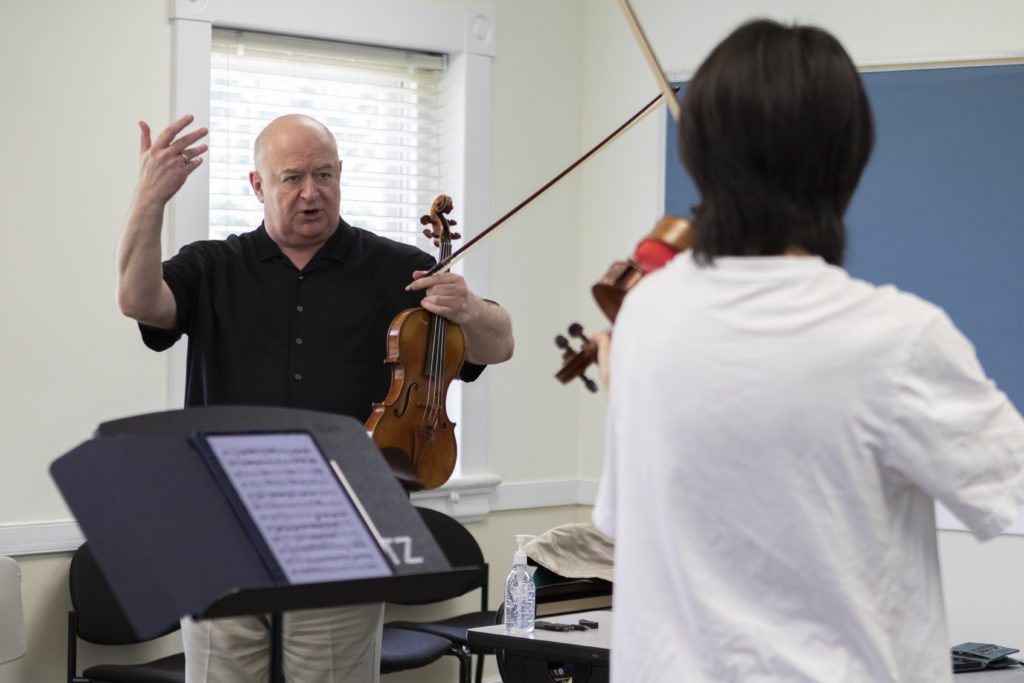
- In-person “Tape & Listen” dress rehearsals and video review sessions with the Institute’s Artistic Director Nicholas Kitchen
- Heifetz Performance & Communication Training courses
- Practice & performance analytics and coaching with professional consultants
- Seminars, masterclasses, lectures, fine instrument exhibitions, and audition opportunities, including From The Top
- A School Fair featuring representatives from the nation’s leading conservatories and music schools
- Industry-leading HD audio and video productions, including live streams, studio recordings, and concert videos on the Heifetz Institute’s popular YouTube, Instagram, and Facebook pages
- Days of Play! Organized hikes, field trips, and outings for Heifetz students to explore the natural beauty and local attractions of Virginia’s Shenandoah Valley
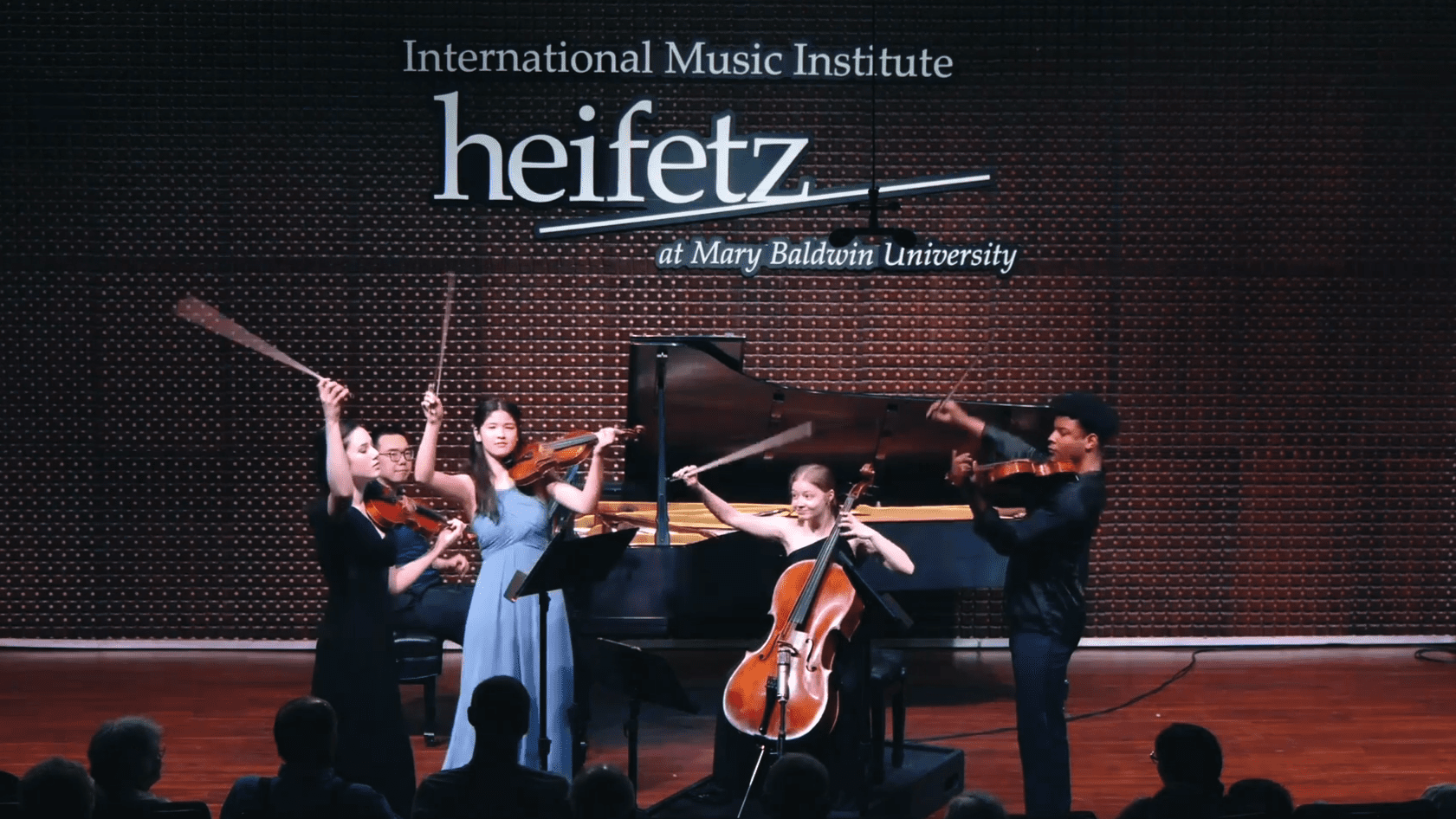
- Daily public concert performance opportunities per week, including:
- 11 Stars of Tomorrow concerts, featuring both solo and chamber music
- 13 Junior Division Showcases
- 6 Celebrity Series concerts featuring Heifetz faculty and select students
- 5 Chamber Music Matinees in the iconic 17th-century Blackfriars Playhouse of the American Shakespeare Center in downtown Staunton
- Special event programs including Heifetz Hootenannies, PianoPalooza, and an event connecting to the special musical history of central Virginia around the Independence Day
- House concerts and Institute Fundraising events
- Outreach performance opportunities in area churches, libraries, and civic events
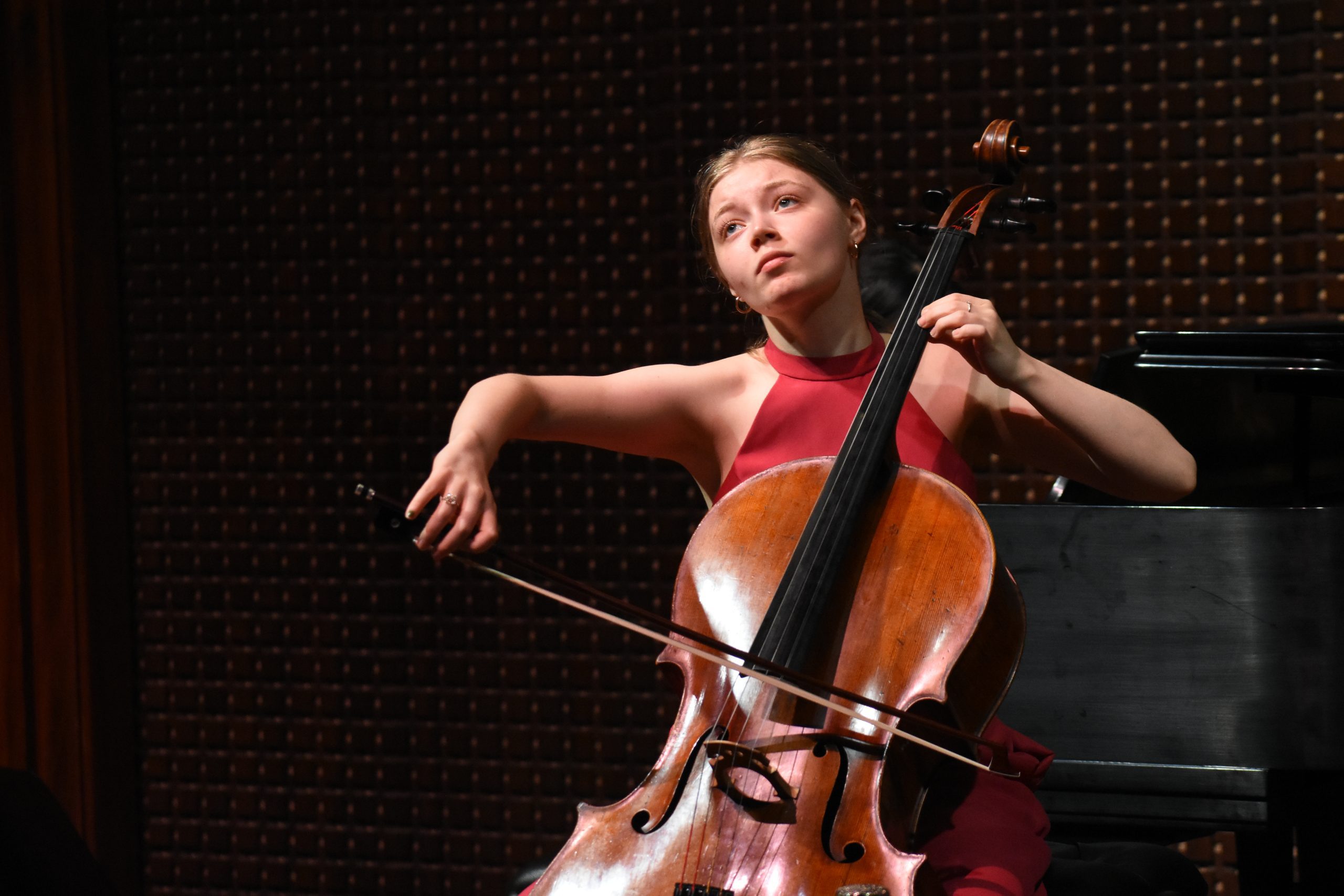
CHAMBER MUSIC SEMINAR DETAILS
The Heifetz Institute Chamber Music Seminar is a program of intense and highly focused study of masterworks of chamber music literature with some of the most renowned instructors in the field.
- Limited to up to 16 participants, who will receive full scholarships (tuition plus room and board) and be recognized as Heifetz Chamber Music Fellows
- Open to Senior Division applicants only (suggested ages 18—30)
- Four to Five chamber coachings per week, plus a weekly Chamber Music Seminar class
- Two private lessons per week
- Four concerts will be dedicated exclusively to complete performances of assigned repertoire by Heifetz Chamber Music Seminar students.

STRING SCHOLAR FELLOWSHIP DETAILS
- Reserved for a select group of exceptional Senior Division musicians (ages 18–30), the Heifetz String Scholar program recognizes top artists who exemplify the Institute’s mission of communication and artistry. Limited to up to eight participants, String Scholars receive additional performance and outreach opportunities, that may include regional and touring engagements before and after the summer session, as well as pride of place in the opening concert of the summer festival.
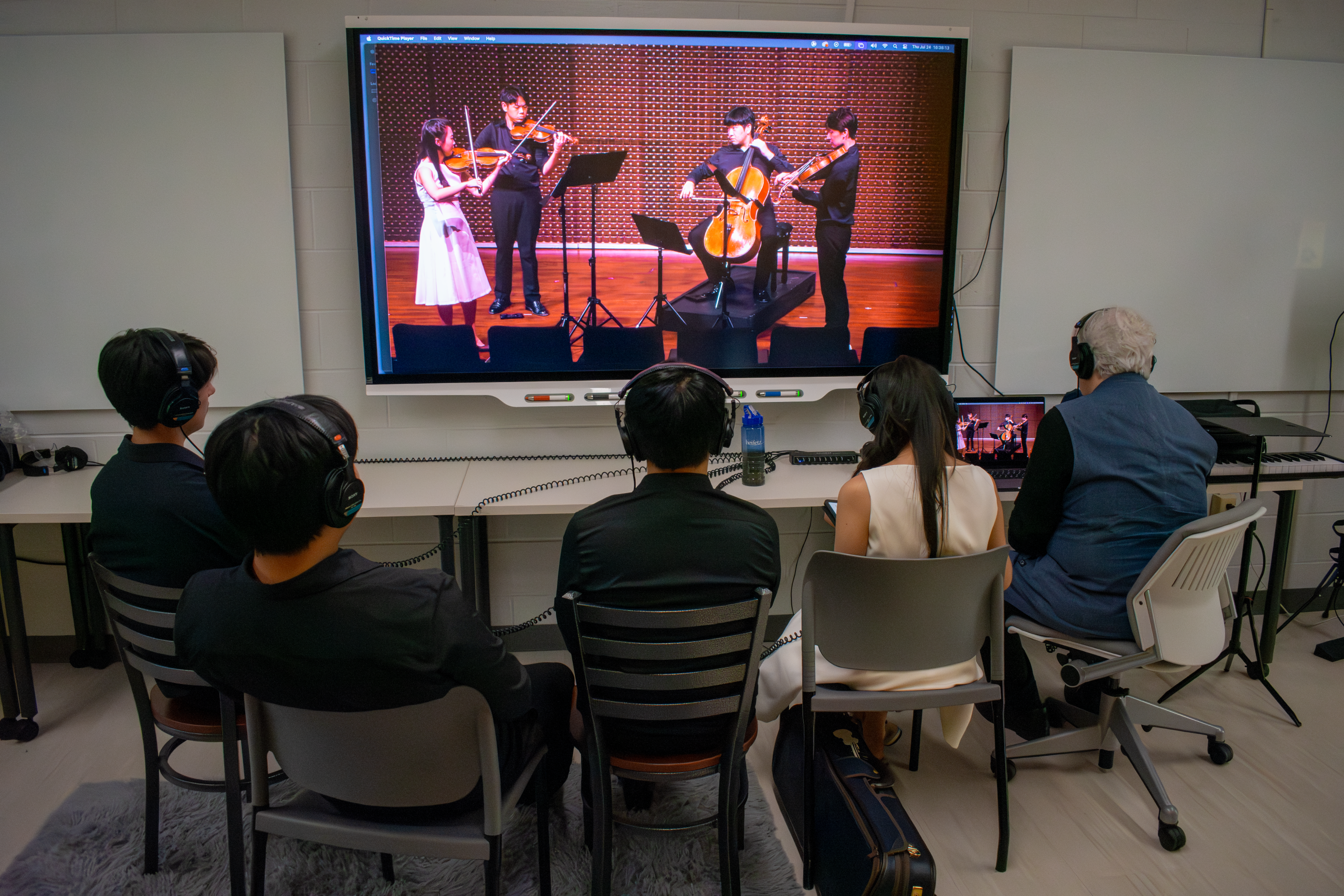
TAPE & LISTEN
Watching and listening to your own performances leads to a better connection to and understanding of your musical and expressive intentions. Immediately following the full dress rehearsals that precede every performance on the Heifetz stage, students will have the opportunity to view a high-quality video playback of their own performance in a private-studio setting under the supervision of the Artistic Director.
Performance & Communication Training
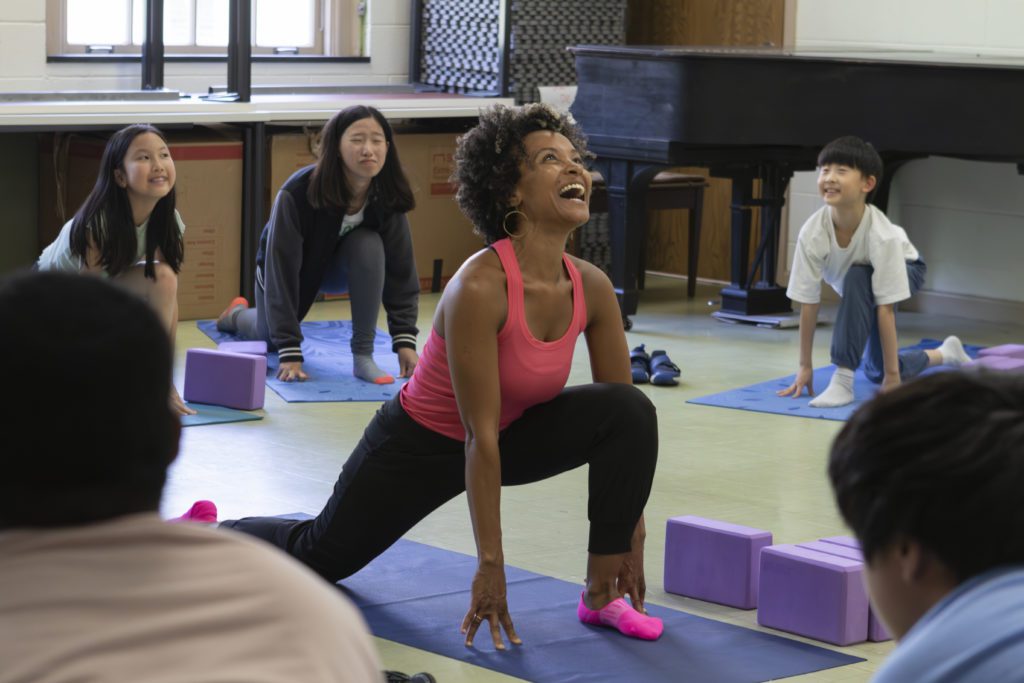
The Heifetz Performance and Communication Training program is a cornerstone of our curriculum, designed to help young musicians unlock their full expressive potential—on stage and beyond. Through singing, movement, and dramatic exercises, students learn to connect their musical performance to the emotional depth of human expression, exploring how voice, body, and instrument work together to communicate powerfully. Whether channeling the passion of Bach, the rhythm of a gigue, or the cadence of a compelling public speech, students discover that true artistry lies in the union of expression, musicianship, and emotion.
Speaking in Public: Your connection with the audience begins the moment you set foot on stage. This class empowers young artists with the skills and confidence to communicate effectively in any setting. Under the guidance of Daniel Pettrow, students will develop techniques drawn from great communicators, learn strategies for crafting engaging and authentic speeches, and practice speaking from a place of clarity, purpose, and presence.
Singing the Phrase: Singing lies at the heart of musical expression. Led by Heifetz Artistic Director Nicholas Kitchen, you’ll explore how singing the musical score reveals phrasing, nuance, and emotional intent. Enormous insights will also come from seeing how great composers used texts with music. By learning to sing and to listen with imagination, you’ll discover how to phrase your music with greater freedom and meaning — connecting voice, heart, and instrument into one expressive whole.
Freedom of Expression & Improvisation: Violinist Eden MacAdam-Somer, chair of New England Conservatory’s Contemporary Musical Arts department, leads students into the world of musical improvisation. Great musical expression requires a genuine, spontaneous connection between performer and listener. Even when performing fully notated music, musicians can learn from actors how to bring written lines to life with spontaneity and authentic expression. Throughout history, musical communication has also been fueled by great improvisers such as J.S. Bach, Beethoven, and Mozart.
Drama: Led by Heifetz Director of Performance & Communication Training Daniel Pettrow, this popular class is designed for performing artists to deepen their personal presence and expand their expressive range. Through guided warm-up techniques, practical exercises, and ensemble work, you’ll explore methods for cultivating authentic stage presence, enhancing dramatic expression, and managing performance anxiety. The course provides a supportive environment for taking creative risks, developing greater confidence, connection, and artistry in performance.
Movement: Learn the history of the Baroque dances that we play. In this class, you’ll investigate how dance, movement, and gesture shape musical phrasing, timing, listening, and ensemble awareness. One student might play Bach while others embody the choreography of a baroque dance, and then you’ll invent your own. By experiencing rhythm physically, you’ll develop a deeper awareness of pulse, space, gesture, and the expressive possibilities of the body.
Yoga: Discover how the mindfulness, balance, and awareness cultivated on the yoga mat can strengthen your musical practice. Led by violinist and yogi Melissa White, whose Intermission Sessions have inspired and supported musicians nationwide, this class combines physical alignment, breath, and focus into your artistic journey – fostering well-being, resilience, and expressive freedom.
PRACTICE TECHNIQUES & BEHAVIORAL ANALYTICS
Behavior consultant and learning architect Adam Hockman is dedicated to helping musicians develop successful practice and performance strategies. He will be available for one-on-one sessions intended to help you make significant strides in your growth as a musician and human being.
Staunton, Virginia
The Heifetz Institute is held on the campus of Mary Baldwin University in Staunton, Virginia. Nestled in the Shenandoah Valley between the Blue Ridge and Allegheny Mountains, Staunton is known for its historic and culturally vibrant downtown and stunning natural beauty. Staunton regularly appears on “Top 10” lists of the nation’s best main streets and small cities in such publications as Vogue, Travel & Leisure, USA Today, and Architectural Digest.
Application Fees & Deadlines
$100 — Applications received by December 31, 2026 (11:59 PM PST)
$125 — Applications received by January 15, 2027 (11:59 PM PST)
$150 — Applications received by the final deadline of January 31, 2027 (11:59 PM PST)
Applications received after January 31, 2027 will be charged a $250 Late Fee and will be considered on a case-by-case basis.
The application fee is not included in tuition. The Institute also offers an Application Fee Assistance Program to help reduce barriers to access and affordability. You may request such assistance here.
Scholarships and Financial Aid
At the discretion of the Admissions Review Committee, the Heifetz Institute will award up to 24 full scholarships for the 2027 program, covering tuition, room, and board. The Institute will also offer multiple partial scholarships. These scholarships will be offered to exceptional applicants across the Institute’s programs, including—but not limited to—student admitted to the Heifetz Chamber Music Seminar and students selected as Heifetz String Scholars, both of which are available only to Senior Division applicants.
The Heifetz Chamber Music Seminar is a highly selective program for exceptional Senior Division musicians, with up to 16 participants selected each summer. Selected Chamber Music Seminar participants receive full scholarships covering tuition, room, and board. The Seminar provides an intensive chamber music experience, including chamber music coachings each week, a weekly seminar, two private lessons per week, and two concerts dedicated to the assigned repertoire. Senior Division applicants may indicate their interest in the Chamber Music Seminar as part of the application. There are no additional audition requirements at the initial application stage.
The Heifetz String Scholar Fellowship recognizes a select group of exceptional Senior Division musicians, ages 18–30, who exemplify the Institute’s commitment to communication and artistry. String Scholars receive full scholarships covering tuition, room, and board, along with additional opportunities to perform, engage with audiences, and serve as ambassadors for the Institute. String Scholars are selected at the end of the application process at the sole discretion of the Artistic Director.
Additional selection processes may be required for certain scholarship opportunities, including interviews with Artistic Director Nicholas Kitchen. Applicants will be contacted with further information if they advance for consideration.
All applicants, regardless of nationality or income level, are eligible for merit-based scholarships and tuition assistance. Applicants seeking need-based financial aid may indicate their interest in the online application. Supporting financial documentation will be requested from applicants who advance in the process.
Audition Guidelines for Heifetz 2027
NEW STREAMLINED AUDITION PROCESS FOR 2027
Applicants are required to submit audition videos recorded in a single, continuous take. This approach is designed to simulate the experience of a live audition and allow the Admissions Review Committee to evaluate your playing as they would in a live performance. Videos may be recorded professionally or with a good quality mobile device. Recording and production quality are not high priority factors in the evaluation; we are interested in getting a clear chance to hear your musical performance. Working with professional recording equipment produces the best quality, but using a good mobile device in a reasonably quiet room is sufficient for us to hear your playing well.
SENIOR DIVISION
- 2 mandatory videos, each 8–10 minutes long, plus an optional 3rd video
- Each video must include two contrasting pieces. At the beginning of each video:
- Introduce yourself.
- State the date the video was recorded.
- Perform both pieces in the same continuous recording.
- When choosing the 5-minute selections, the timing is approximate and you should choose a reasonably satisfying stopping place even if it is not exactly 5 minutes. It is fine to play from the beginning of the selected movement, but feel free to choose a different starting point. The goal is to demonstrate your control of what you find the most interesting and challenging parts of that particular piece of music.
VIDEO 1: BACH & CONCERTO
A) J.S. Bach Movement — 3.5–5 minutes
Select a movement from the six Sonatas and Partitas for solo violin (BWV 1001–1006) or a suitable transcription of a movement from the six Suites for solo cello (BWV 1007–1012). If your selection is 3.5–5 minutes, perform the complete selection. If your selected movement is less than 2 minutes, please include an additional short movement or movement section. If your selection is longer than 5 minutes, perform approximately 5 minutes and choose a natural stopping point.
B) Concerto movement — approximately 5 minutes
Select approximately 5 minutes from a movement of one of the following concertos. The selection may be performed with or without piano accompaniment. When a cadenza is included in the movement, please include it in your recording, even if doing so requires skipping ahead to the cadenza.
- Bartók — Violin Concerto No. 1 or No. 2
- Beethoven — Violin Concerto, Op. 61
- Brahms — Violin Concerto, Op. 77
- Bruch — Violin Concerto No. 1 in G minor; Violin Concerto No. 2 in D minor; or Scottish Fantasy, Op. 46
- Dvořák — Violin Concerto
- Korngold — Violin Concerto
- Lalo — Symphonie espagnole, Op. 21
- Mendelssohn — Violin Concerto, Op. 64
- Mozart — Violin Concerto No. 3, K. 216; No. 4, K. 218; or No. 5, K. 219
- Paganini — Violin Concerto No. 1 or No. 2
- Saint-Saëns — Violin Concerto No. 3, Op. 61
- Shostakovich — Violin Concerto No. 1, Op. 77
- Sibelius — Violin Concerto, Op. 47
- Tchaikovsky — Violin Concerto, Op. 35
- Vieuxtemps — Violin Concerto No. 4 or No. 5
- Walton — Violin Concerto
- Wieniawski — Violin Concerto No. 1 or No. 2
VIDEO 2: VIRTUOSO PIECE & MOZART CHAMBER MUSIC EXCERPT
A) Virtuoso piece — approximately 5 minutes
Select a virtuoso work (see the reference list below*) that demonstrates your artistry and technical abilities. May be performed with or without piano accompaniment.
B) Mozart chamber music excerpt
Perform the excerpt specified for your instrument (sheet music is available here):
- Violin: String Quartet No. 14 in G major, K. 387 — III. Andante cantabile (Violin I) 7 — Measures 1 – 25
*Virtuoso Work — Reference Repertoire (May be performed with or without piano accompaniment)
- Bartók — Rhapsody No. 1 or Rhapsody No. 2; Violin Sonata No. 1, last movement; Sonata for Solo Violin, any movement
- Beethoven — Romance in F major; Romance in G major; Violin Sonata No. 9 (“Kreutzer”), first movement
- Brahms — Violin Sonata No. 3, Op. 108, fourth movement
- Chausson — Poème, Op. 25
- Ernst — The Last Rose of Summer
- Franck — Violin Sonata, second or fourth movement
- Hindemith — Sonata for Solo Violin, Op. 31, No. 1, first, third, or fifth movement
- Paganini — Any showpiece, such as I Palpiti, or any Caprice
- Poulenc — Violin Sonata, first or third movement
- Prokofiev — Violin Sonata No. 1 in F minor, first, second, or fourth movement; Violin Sonata No. 2 in D major, second or fourth movement
- Ravel — Tzigane; Violin Sonata, last movement
- Saint-Saëns — Introduction and Rondo Capriccioso, Op. 28; Havanaise, Op. 83; Violin Sonata No. 1, last movement
- Sarasate — Introduction and Tarantella, Op. 43; Zigeunerweisen, Op. 20; Zapateado, Op. 23; Carmen Fantasy, Op. 25; other works may also be considered
- Schumann — Violin Sonata No. 1, Op. 105, fourth movement
- Strauss — Violin Sonata, first or third movement
- Wieniawski — Polonaise brillante No. 1 or No. 2; Faust Fantasy; Variations on an Original Theme; Scherzo-Tarantelle; one of the Études
- Ysaÿe — Six Sonatas for Solo Violin, any sonata or movement
VIDEO 3: OPTIONAL LIVE PERFORMANCE
Applicants may optionally submit a video of a live performance or a studio-made video, either solo or chamber music. The performance must be from no earlier than January 1, 2026, and may feature the same piece submitted for either of the required audition videos. This might include:
- Solo sonata performance
- Chamber music performance
- Performance with piano
- Performance with orchestra
At the beginning of the video, please identify the date of the performance and, whenever possible, identify the other musicians performing with you.
VIDEO 1: BACH & CONCERTO
A) J.S. Bach Movement — 3.5–5 minutes
Select a movement from the six Suites for solo cello (BWV 1007–1012) or a suitable transcription from the six Sonatas and Partitas for solo violin (BWV 1001–1006). If your selection is 3.5–5 minutes, perform the complete selection. If your selected movement is less than 2 minutes, please include an additional short movement or movement section. If your selection is longer than 5 minutes, perform approximately 5 minutes and choose a natural stopping point.
B) Concerto movement — approximately 5 minutes
Select approximately 5 minutes from a movement of one of the following concertos. The selection may be performed with or without piano accompaniment. When a cadenza is included in the movement, please include it in your recording, even if doing so requires skipping ahead to the cadenza.
- Bartók — Viola Concerto
- Dvořák — Transcription of Cello Concerto
- Elgar — Transcription of Cello Concerto
- Hoffmeister — Viola Concerto, with cadenza
- Hindemith — Der Schwanendreher
- Rosza — Viola Concerto
- Stamitz — Viola Concerto, with cadenza
- Walton — Viola Concerto
VIDEO 2: VIRTUOSO PIECE & MOZART CHAMBER MUSIC EXCERPT
A) Virtuoso piece — approximately 5 minutes
Select a virtuoso work (see the reference list below*) that demonstrates your artistry and technical abilities. May be performed with or without piano accompaniment.
B) Mozart chamber music excerpt
Perform the excerpt specified for your instrument (sheet music is available here):
- Viola: String Quartet No. 15 in D minor, K. 421 — IV. Allegretto ma non troppo – Più allegro (Viola variation) — Measures 73 – 96
*Virtuoso Work — Reference Repertoire (May be performed with or without piano accompaniment)
- Bowen — Viola Sonata, last movement
- Clarke — Viola Sonata, first movement
- Hindemith — Sonatas for Viola, Op. 11
- Paganini — La Campanella
- Penderecki — Cadenza
- Reger — Solo Sonatas for Viola
- Vieuxtemps — Viola Sonata
VIDEO 3: OPTIONAL LIVE PERFORMANCE
Applicants may optionally submit a video of a live performance, either solo or chamber music. The performance must be from no earlier than January 1, 2026, and may feature the same piece submitted for either of the required audition videos. This might include:
- Solo sonata performance
- Chamber music performance
- Performance with piano
- Performance with orchestra
At the beginning of the video, please identify the date of the performance and, whenever possible, identify the other musicians performing with you.
VIDEO 1: BACH & CONCERTO
A) J.S. Bach Movement — 3.5–5 minutes
Select a movement from the six Suites for solo cello (BWV 1007–1012). If your selection is 3.5–5 minutes, perform the complete selection. If your selected movement is less than 2 minutes, please include an additional short movement or movement section. If your selection is longer than 5 minutes, perform approximately 5 minutes and choose a natural stopping point.
B) Concerto movement — approximately 5 minutes
Select approximately 5 minutes from a movement of one of the following concertos. The selection may be performed with or without piano accompaniment. When a cadenza is included in the movement, please include it in your recording, even if doing so requires skipping ahead to the cadenza.
- Barber — Cello Concerto, Op. 22
- Bloch — Schelomo
- Britten — Cello Symphony, Op. 68
- Dvořák — Cello Concerto in B minor, Op. 104
- Elgar — Cello Concerto in E minor, Op. 85
- Haydn — Cello Concerto in C major or Cello Concerto in D major
- Lalo — Cello Concerto in D minor
- Prokofiev — Symphony-Concerto, Op. 125
- Saint-Saëns — Cello Concerto No. 1 in A minor, Op. 33
- Schumann — Cello Concerto in A minor, Op. 129
- Shostakovich — Cello Concerto No. 1 in E-flat major, Op. 107
- Tchaikovsky — Variations on a Rococo Theme, Op. 33
- Walton — Cello Concerto
VIDEO 2: VIRTUOSO PIECE & MOZART CHAMBER MUSIC EXCERPT
A) Virtuoso piece — approximately 5 minutes
Select a virtuoso work (see the reference list below*) that demonstrates your artistry and technical abilities. May be performed with or without piano accompaniment.
B) Mozart chamber music excerpt
Perform the excerpt specified for your instrument (sheet music is available here):
- Cello: String Quartet No. 22 in B♭ major, K. 589 — II. Larghetto — Measures 1 – 8; 75 – 83
*Virtuoso Work — Reference Repertoire (May be performed with or without piano accompaniment)
- Brahms — Cello Sonata No. 1, Op. 99, first movement
- Cassadó — Dance of the Green Devil and other works; Suite for Solo Cello
- Chopin — Polonaise brillante
- Crumb — Sonata for Solo Cello
- Davidov — At the Fountain and other works
- Debussy — Cello Sonata, third movement
- Fauré — Élégie or Papillon
- Kodály — Sonata for Solo Cello, Op. 8
- Ligeti — Sonata for Solo Cello
- Piatti — Caprices
- Popper — Elfentanz and other works; selected Caprices: Nos. 4, 6, 9, 12–14, 20, 24, 29, 32–33, 35–36, 38–40
- Poulenc — Cello Sonata, first or fourth movement
- Prokofiev — Cello Sonata in C major, Op. 119, first, second, or fourth movement
- Schubert — Arpeggione Sonata, first movement
- Shostakovich — Cello Sonata in D minor, Op. 40, first, second, or fourth movement
- Tchaikovsky — Pezzo capriccioso, Op. 62
- Ysaÿe — Sonata for Solo Cello
VIDEO 3: OPTIONAL LIVE PERFORMANCE
Applicants may optionally submit a video of a live performance, either solo or chamber music. The performance must be from no earlier than January 1, 2026, and may feature the same piece submitted for either of the required audition videos. This might include:
- Solo sonata performance
- Chamber music performance
- Performance with piano
- Performance with orchestra
At the beginning of the video, please identify the date of the performance and, whenever possible, identify the other musicians performing with you.
JUNIOR DIVISION:
- 1 mandatory video, 8–10 minutes long, plus an optional 2nd video
- Video must include two contrasting pieces. At the beginning of the video:
- Introduce yourself.
- State the date the video was recorded.
- Perform both pieces in the same continuous recording.
- When choosing the 5-minute selections, the timing is approximate and you should choose a reasonably satisfying stopping place even if it is not exactly 5 minutes. It is fine to play from the beginning of the selected movement, but feel free to choose a different starting point. The goal is to demonstrate your control of what you find the most interesting and challenging parts of that particular piece of music.
VIDEO 1: BACH & CONCERTO or VIRTUOSO
A) J.S. Bach Movement — 3.5–5 minutes
Select a movement from the six Sonatas and Partitas for solo violin (BWV 1001–1006) or a suitable transcription of a movement from the six Suites for solo cello (BWV 1007–1012). If your selection is 3.5–5 minutes, perform the complete selection. If your selected movement is less than 2 minutes, please include an additional short movement or movement section. If your selection is longer than 5 minutes, perform approximately 5 minutes and choose a natural stopping point.
B) Concerto movement OR Virtuoso Piece (please submit one or the other)— approximately 5 minutes
- Select approximately 5 minutes from a movement of one of the following concertos. The selection may be performed with or without piano accompaniment. When a cadenza is included in the movement, please include it in your recording, even if doing so requires skipping ahead to the cadenza.
- Bartók — Violin Concerto No. 1 or No. 2
- Beethoven — Violin Concerto, Op. 61
- Brahms — Violin Concerto, Op. 77
- Bruch — Violin Concerto No. 1 in G minor; Violin Concerto No. 2 in D minor; or Scottish Fantasy, Op. 46
- Dvořák — Violin Concerto
- Korngold — Violin Concerto
- Lalo — Symphonie espagnole, Op. 21
- Mendelssohn — Violin Concerto, Op. 64
- Mozart — Violin Concerto No. 3, K. 216; No. 4, K. 218; or No. 5, K. 219
- Paganini — Violin Concerto No. 1 or No. 2
- Saint-Saëns — Violin Concerto No. 3, Op. 61
- Shostakovich — Violin Concerto No. 1, Op. 77
- Sibelius — Violin Concerto, Op. 47
- Tchaikovsky — Violin Concerto, Op. 35
- Vieuxtemps — Violin Concerto No. 4 or No. 5
- Walton — Violin Concerto
- Wieniawski — Violin Concerto No. 1 or No. 2
- Select a virtuoso work (see the reference list below) that demonstrates your artistry and technical abilities. May be performed with or without piano accompaniment.
- Bartók — Rhapsody No. 1 or Rhapsody No. 2; Violin Sonata No. 1, last movement;
- Sonata for Solo Violin, any movement
- Beethoven — Romance in F major; Romance in G major; Violin Sonata No. 9 (“Kreutzer”), first movement
- Brahms — Violin Sonata No. 3, Op. 108, fourth movement
- Chausson — Poème, Op. 25
- Ernst — The Last Rose of Summer
- Franck — Violin Sonata, second or fourth movement
- Hindemith — Sonata for Solo Violin, Op. 31, No. 1, first, third, or fifth movement
- Paganini — Any showpiece, such as I Palpiti, or any Caprice
- Poulenc — Violin Sonata, first or third movement
- Prokofiev — Violin Sonata No. 1 in F minor, first, second, or fourth movement; Violin Sonata No. 2 in D major, second or fourth movement
- Ravel — Tzigane; Violin Sonata, last movement
- Saint-Saëns — Introduction and Rondo Capriccioso, Op. 28; Havanaise, Op. 83; Violin Sonata No. 1, last movement
- Sarasate — Introduction and Tarantella, Op. 43; Zigeunerweisen, Op. 20; Zapateado, Op. 23; Carmen Fantasy, Op. 25; other works may also be considered
- Schumann — Violin Sonata No. 1, Op. 105, fourth movement
- Strauss — Violin Sonata, first or third movement
- Wieniawski — Polonaise brillante No. 1 or No. 2; Faust Fantasy; Variations on an Original Theme; Scherzo-Tarantelle; one of the Études
- Ysaÿe — Six Sonatas for Solo Violin, any sonata or movement
VIDEO 2: OPTIONAL LIVE PERFORMANCE
Applicants may optionally submit a video of a live performance or a studio-made video, either solo or chamber music. The performance must be from no earlier than January 1, 2026, and may feature the same piece submitted for either of the required audition videos. This might include:
- Solo sonata performance
- Chamber music performance
- Performance with piano
- Performance with orchestra
At the beginning of the video, please identify the date of the performance and, whenever possible, identify the other musicians performing with you.
VIDEO 1: BACH & CONCERTO or VIRTUOSO
A) J.S. Bach Movement — 3.5–5 minutes
Select a movement from the six Suites for solo cello (BWV 1007–1012) or a suitable transcription from the six Sonatas and Partitas for solo violin (BWV 1001–1006). If your selection is 3.5–5 minutes, perform the complete selection. If your selected movement is less than 2 minutes, please include an additional short movement or movement section. If your selection is longer than 5 minutes, perform approximately 5 minutes and choose a natural stopping point.
B) Concerto movement OR Virtuoso Piece (please submit one or the other)— approximately 5 minutes
- Select approximately 5 minutes from a movement of one of the following concertos. The selection may be performed with or without piano accompaniment. When a cadenza is included in the movement, please include it in your recording, even if doing so requires skipping ahead to the cadenza.
- Bartók — Viola Concerto
- Dvořák — Transcription of Cello Concerto
- Elgar — Transcription of Cello Concerto
- Hoffmeister — Viola Concerto, with cadenza
- Hindemith — Der Schwanendreher
- Rosza — Viola Concerto
- Stamitz — Viola Concerto, with cadenza
- Walton — Viola Concerto
- Select a virtuoso work (see the reference list below) that demonstrates your artistry and technical abilities. May be performed with or without piano accompaniment.
- Bowen — Viola Sonata, last movement
- Clarke — Viola Sonata, first movement
- Hindemith — Sonatas for Viola, Op. 11
- Paganini — La Campanella
- Penderecki — Cadenza
- Reger — Solo Sonatas for Viola
- Vieuxtemps — Viola Sonata
VIDEO 2: OPTIONAL LIVE PERFORMANCE
Applicants may optionally submit a video of a live performance, either solo or chamber music. The performance must be from no earlier than January 1, 2026, and may feature the same piece submitted for either of the required audition videos. This might include:
- Solo sonata performance
- Chamber music performance
- Performance with piano
- Performance with orchestra
At the beginning of the video, please identify the date of the performance and, whenever possible, identify the other musicians performing with you.
VIDEO 1: BACH & CONCERTO or VIRTUOSO
A) J.S. Bach Movement — 3.5–5 minutes
Select a movement from the six Suites for solo cello (BWV 1007–1012). If your selection is 3.5–5 minutes, perform the complete selection. If your selected movement is less than 2 minutes, please include an additional short movement or movement section. If your selection is longer than 5 minutes, perform approximately 5 minutes and choose a natural stopping point.
B) Concerto movement OR Virtuoso Piece (please submit one or the other)— approximately 5 minutes
- Select approximately 5 minutes from a movement of one of the following concertos. The selection may be performed with or without piano accompaniment. When a cadenza is included in the movement, please include it in your recording, even if doing so requires skipping ahead to the cadenza.
- Barber — Cello Concerto, Op. 22
- Bloch — Schelomo
- Britten — Cello Symphony, Op. 68
- Dvořák — Cello Concerto in B minor, Op. 104
- Elgar — Cello Concerto in E minor, Op. 85
- Haydn — Cello Concerto in C major or Cello Concerto in D major
- Lalo — Cello Concerto in D minor
- Prokofiev — Symphony-Concerto, Op. 125
- Saint-Saëns — Cello Concerto No. 1 in A minor, Op. 33
- Schumann — Cello Concerto in A minor, Op. 129
- Shostakovich — Cello Concerto No. 1 in E-flat major, Op. 107
- Tchaikovsky — Variations on a Rococo Theme, Op. 33
- Walton — Cello Concerto
- Select a virtuoso work (see the reference list below) that demonstrates your artistry and technical abilities. May be performed with or without piano accompaniment.
- Brahms — Cello Sonata No. 1, Op. 38, first movement
- Cassadó — Dance of the Green Devil and other works; Suite for Solo Cello
- Chopin — Polonaise brillante
- Crumb — Sonata for Solo Cello
- Davidov — At the Fountain and other works
- Debussy — Cello Sonata, third movement
- Fauré — Élégie or Papillon
- Kodály — Sonata for Solo Cello, Op. 8
- Ligeti — Sonata for Solo Cello
- Piatti — Caprices
- Popper — Elfentanz and other works; selected Caprices: Nos. 4, 6, 9, 12–14, 20, 24, 29, 32–33, 35–36, 38–40
- Poulenc — Cello Sonata, first or fourth movement
- Prokofiev — Cello Sonata in C major, Op. 119, first, second, or fourth movement
- Schubert — Arpeggione Sonata, first movement
- Shostakovich — Cello Sonata in D minor, Op. 40, first, second, or fourth movement
- Tchaikovsky — Pezzo capriccioso, Op. 62
- Ysaÿe — Sonata for Solo Cello
VIDEO 2: OPTIONAL LIVE PERFORMANCE
Applicants may optionally submit a video of a live performance, either solo or chamber music. The performance must be from no earlier than January 1, 2026, and may feature the same piece submitted for either of the required audition videos. This might include:
- Solo sonata performance
- Chamber music performance
- Performance with piano
- Performance with orchestra
At the beginning of the video, please identify the date of the performance and, whenever possible, identify the other musicians performing with you.
Tuition
(2026 rates; figures are subject to change for 2027)
6-Week Program:
(Junior & Senior Division)
- Twice-a-week private lessons, and/or classroom instruction and coachings with studio teachers
- Access to all other Institute instruction, Communication Training classes, master classes, group studio class, guaranteed rehearsal time with pianists, etc.
- Including air-conditioned single- or double-occupancy dorm rooms, dedicated practice rooms, dining facilities, and parking permits on the Mary Baldwin University campus in Staunton, VA
- Guaranteed transportation to and from IAD, CHO, or SHD airports and STA or CVS train stations
- Transportation to and from student activity locations
- Access to campus-wide wireless internet (Must have U.S. cell phone number)
- Access to the Heifetz Institute music library and photocopying privileges, including payment of compulsory license fees to music publication agencies
- Access to Heifetz Institute software and peripherals, including page-turning pedals.
- Quarantine facilities, if necessary
- 24/7 coverage and transportation to and from local health care facilities, including emergency room service
- Mandatory for access to on-campus dining facilities
- Free admission to local YMCA
- Grants free admission to all Heifetz events
- Enables discounts on purchases at the Heifetz Music Shop and other downtown Staunton businesses.
- An archive of all of the Heifetz Institute’s state-of-the-art concert live streams will be available for all students. Single-camera video and HD audio of any concert performances may be available upon request.
3-Week Program
(Junior Division Only)
- Twice-a-week private lessons, and/or classroom instruction and coachings with studio teachers
- Access to all other Institute instruction, Communication Training classes, master classes, group studio class, guaranteed rehearsal time with pianists, etc.
- Including air-conditioned single- or double-occupancy dorm rooms, dedicated practice rooms, dining facilities, and parking permits on the Mary Baldwin University campus in Staunton, VA
- Guaranteed transportation to and from IAD, CHO, or SHD airports and STA or CVS train stations
- Transportation to and from student activity locations
- Access to campus-wide wireless internet (Must have U.S. cell phone number)
- Access to the Heifetz Institute music library and photocopying privileges, including payment of compulsory license fees to music publication agencies
- Access to Heifetz Institute software and peripherals, including page-turning pedals.
- Quarantine facilities, if necessary
- 24/7 coverage and transportation to and from local health care facilities, including emergency room service
- Mandatory for access to on-campus dining facilities
- Free admission to local YMCA
- Grants free admission to all Heifetz events
- Enables discounts on purchases at the Heifetz Music Shop and other downtown Staunton businesses.
- An archive of all of the Heifetz Institute’s state-of-the-art concert live streams will be available for all students. Single-camera video and HD audio of any concert performances may be available upon request.
Tuition Deposit
Upon acceptance, admitted students will receive an itemized Financial Statement detailing tuition, fees, and any need- or merit- based scholarship awards. The statement will detail the overall cost to the student, the required tuition deposit, the balance amount, and due date. The tuition deposit will be due within two weeks of receiving the acceptance letter and financial statement. Deposits shall not be refunded if the student chooses to withdraw from the Institute.
Remaining Balance
All tuition and fee payments must be completed by April 15, 2027. Payments made by mail need to be postmarked by this date. Payments may be made online via the QuickBooks invoice sent at the time of enrollment and following receipt of the tuition deposit. There is a 3% credit/debit card processing fee for all online payments. Checks, made payable to “Heifetz International Music Institute” may be sent to:
Heifetz International Music Institute
PO Box 2447
Staunton, VA 24402
For payments via wire transfer, contact accounts@heifetzinstitute.org. A single payment for the full cost of attendance is preferred (with the exception of the tuition deposit), but an installment plan is available on an as-needed basis. For more information on installment plans, contact accounts@heifetzinstitute.org.
Refund Policy
Application fees and tuition deposits are non-refundable. Any payments made on or after the April 15, 2027 deadline for the Remaining Balance are non-refundable. If a student is forced to withdraw for health and/or injury reasons, they will be automatically re-enrolled for the following summer, and any fees paid to date will be applied to their next year’s tuition. In the event of program cancellation, all deposits, tuition, and fees will be fully refunded.
Frequently Asked Questions
When do applications for the 2027 Summer Program open?
Our application portal opens by November 15, 2026
What is the application deadline for the 2027 Summer Program?
The deadline is January 31, 2027
Do you offer financial aid?
What are the audition requirements for the 2027 Summer Program?
You can find our updated audition requirements in the section titled “Audition Requirements.”
Does [enter name of piece] fulfill your audition requirement?
- Check our audition requirements and compare your piece to the examples provided.
- If you are still in doubt, we suggest you speak with your private teacher about your repertoire selections.
- Check out our YouTube channel for repertoire selection ideas.
What are the dates for the 2027 Summer Program?
- June 18, 2027: Arrival for Senior Division & Junior Division Session I
- July 10, 2027: Final Concerts and Departure for Junior Division Session I
- July 11, 2027: Arrival for Junior Division Session II (12:00 PM EDT)
- July 31, 2027: Final Concerts for Senior Division & Junior Division Session II
- August 1, 2027: Departure for all students (12:00 PM EDT)
Can I arrive late?
My child is 10 years old, can they live off-campus?
Junior Division students under the age of 10 (as of June 14, 2027) will be required to live off-campus with at least one parent or guardian. All other students are required to live on campus.